


Linear Voice Coil Motor Actuator LVCM-013-019-02, Continuous Force: 2.9 oz (0.81 N), Stroke: 0.50 inch (12.7 mm)
 |
 |
 |
| Housing Outside Diameter, 0.500 inch, 12.7 mm | ||||||||
|
||||||||
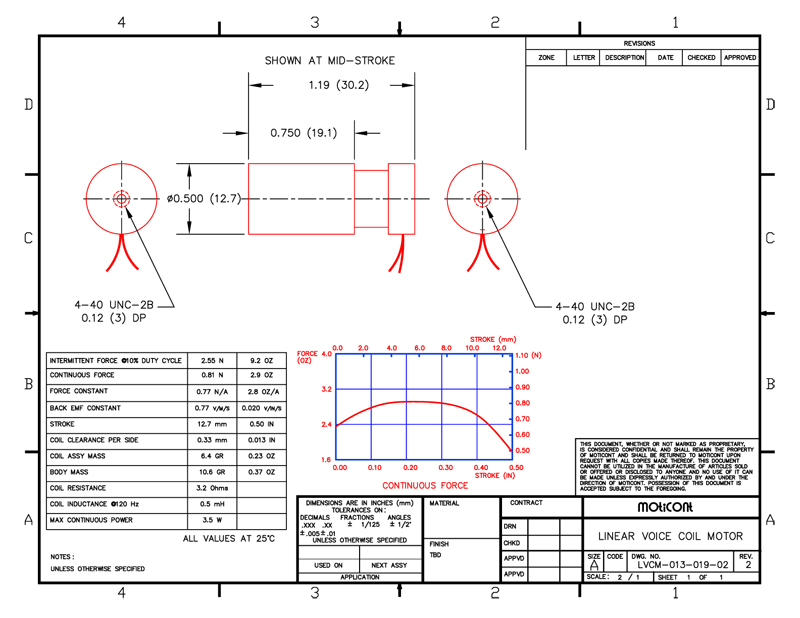
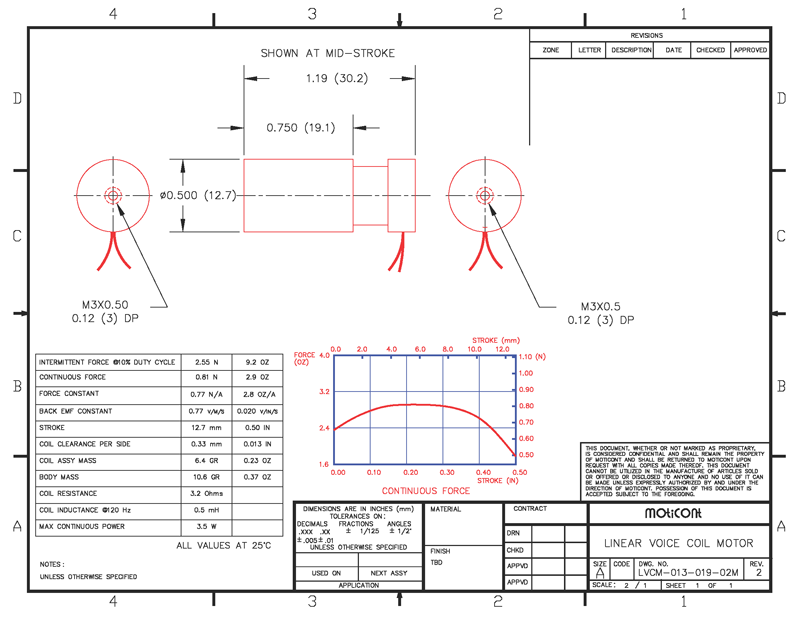
Product OverviewThe LVCM-013-019-02 is a miniature brushless linear voice coil motor designed for fast, precise, bidirectional motion. It provides a 0.50 inch (12.7 mm) stroke, 2.9 oz (0.81 N) of continuous force, and 9.2 oz (2.55 N) of intermittent force at a 10% duty cycle. The housing measures 0.500 inch (12.7 mm) in outside diameter and 0.750 inch (19.1 mm) long.Performance and ConstructionThe non-commutated direct-drive design produces force proportional to coil current and reverses direction when current polarity is reversed. With no brushes, gears, lead screws, or mechanical transmission components, the motor provides smooth force control, zero cogging, rapid acceleration and deceleration, quiet operation, and long service life. Direct coupling to the load eliminates transmission backlash.Key Features• 0.50 inch (12.7 mm) bidirectional linear stroke• 2.9 oz (0.81 N) continuous force • 9.2 oz (2.55 N) intermittent force at 10% duty cycle • Brushless, non-commutated operation with no cogging • Direct-drive response with zero mechanical backlash when coupled directly to the load • Smooth force proportional to input current • High acceleration, rapid reversal, and low mechanical wear • Threaded mounting provisions for straightforward system integration ApplicationsMedical and Laboratory Equipment: Haptic interfaces, diagnostic instruments, sampling systems, pharmaceutical equipment, and laboratory automation.Optical and Laser Systems: Beam steering, focusing, scanning, filtering, laser machining, and precision optical positioning. Semiconductor Equipment: Wafer handling, inspection, alignment, and other short-stroke precision processes. Vibration and Force Control: Active damping, dynamic force generation, test equipment, and vibration cancellation. Mechanical Integration and Closed-Loop ControlThe LVCM-013-019-02 generates linear force but does not provide its own mechanical guidance. The moving and stationary components should be supported by an external bearing, flexure, slide, or other guidance mechanism. For position, velocity, or programmed motion control, combine the motor with a suitable position sensor, servo controller, and current amplifier. Final accuracy and repeatability depend on the feedback sensor, guidance system, load, structural stiffness, controller, and servo tuning. | ||||||||
| Imperial Model # | Stroke | Continuous Force | Intermittent Force @ 10% Duty Cycle | Housing Length | ||||
| LVCM-013-019-02 | 0.50 | inch | 2.9 | oz | 9.2 | oz | 0.750 | inch |
Datasheet in PDF  |
12.7 | mm | 0.81 | N | 2.55 | N | 19.1 | mm |
Drawing quick view
 |
Download 3D STEP |
|||||||

| ||||||||
| Metric Model # | Stroke | Continuous Force | Intermittent Force @ 10% Duty Cycle | Housing Length | ||||
| LVCM-013-019-02M | 0.50 | inch | 2.9 | oz | 9.2 | oz | 0.750 | inch |
|
Datasheet in PDF |
12.7 | mm | 0.81 | N | 2.55 | N | 19.1 | mm |
Drawing quick view
 |
Download 3D STEP |
|||||||
|
| ||||||||

| Share this page: |
| Tweet |


